
WELCOME BONUS 300%
UP TO €2000 + 100
FREE SPINS
UP TO €2000 + 100
FREE SPINS
Home → Blackjack
Blackjack at Spinko: Variants, Rules and Payouts
Surrender or Play On With 16 Against a 10
Blackjack Surrender allows the player to give up the hand after the dealer has checked for blackjack and lose half the stake, which improves the return by about 0.08 percentage points. The same rule set appears in Blackjack Liberal Vegas Strip, where late surrender sits alongside S17, DAS and resplit for an RTP of 99.72% and a house edge of 0.28%. On a €10 bet, surrendering returns €5 instead of risking the full stake against a dealer ten.
Playing out a hard 16 against a dealer ten means hitting and busting on any card above five, so the round ends with nothing returned. Folding instead returns 50% of the stake, and on a €20 bet that is €10 back rather than a likely zero. The rule modifier is worth roughly 0.08 percentage points of RTP across a session, which on 100 € of stakes is about 0.08 €.
Early surrender is worth far more, up to 0.6 percentage points, but it is extremely rare and most tables do not offer it. Blackjack 6 decks with S17, DAS, DOA and a 3:2 payout reaches an RTP of 99.54% and a house edge of 0.46% without any surrender option at all. The gap between the two rule sets is 0.08 percentage points, small per hand but visible over hundreds of rounds.
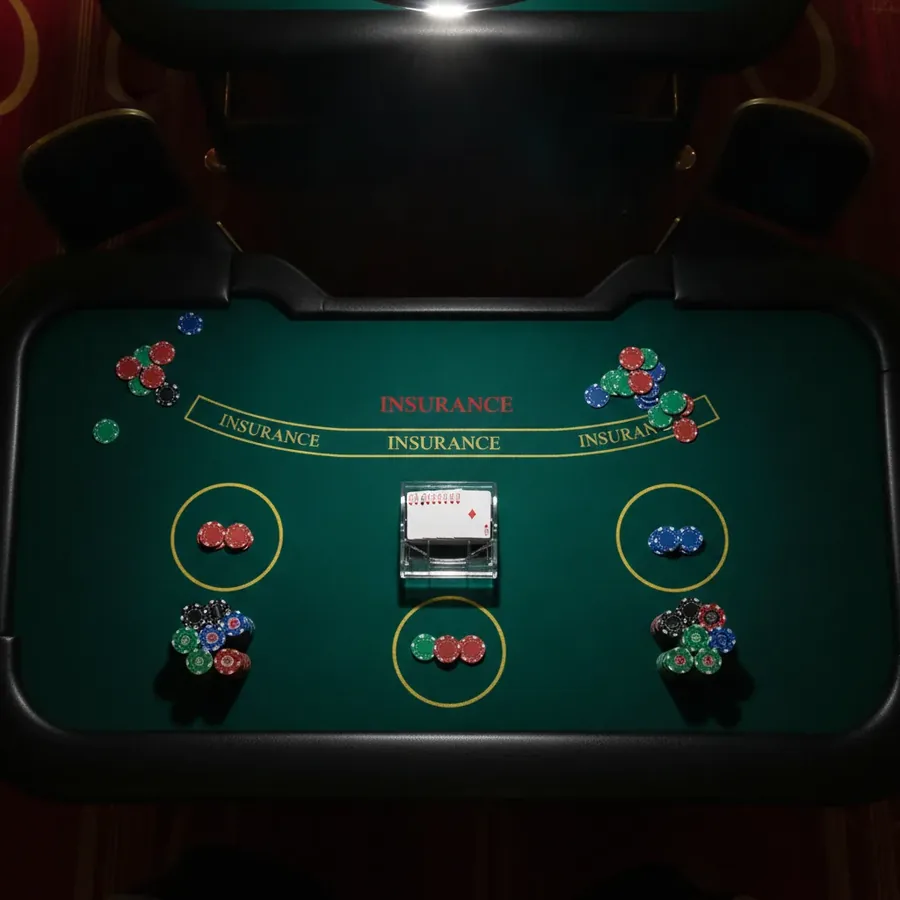
Split Aces: Only One Card per Hand
When aces are split, each hand usually receives one card only, and resplitting aces improves the return by about 0.08 percentage points. In Blackjack Liberal Vegas Strip the resplit rule sits inside a set that also includes S17, DAS and late surrender, giving an RTP of 99.72% and a house edge of 0.28%. Doubling after a split, known as DAS, is worth about 0.14 percentage points on its own.
A split hand with one card cannot be hit further, so an ace plus a ten is an automatic 21 and pays 1:1 rather than the 3:2 that a natural blackjack pays. On a €10 bet that is €10 instead of €15, a difference of €5 per occurrence. A six-deck game with S17, DAS, DOA and a 3:2 payout reaches 99.54% RTP and a 0.46% house edge, and the ace-split restriction is part of that figure.
Splitting aces against a dealer six is common, but with one card per hand the outcome is fixed the moment the card lands. The player can split up to four hands in the standard rule set, so a €10 bet can become four hands of €10 each, or €40 at risk. The resplit-aces rule adds 0.08 percentage points of RTP compared with a table that forbids it.
Soft vs Hard Hands in Practice
A soft hand contains an ace counted as eleven, so a soft 17 is an ace plus a six and can be hit without busting because the ace drops to one. A hard hand has no ace counted as eleven, so a hard 16 busts on any card above five. The dealer hitting soft 17 lowers the return by 0.22 percentage points, while the dealer standing on soft 17 keeps the higher figure.
Blackjack 6 decks with S17, DAS, DOA and a 3:2 payout reaches an RTP of 99.54% and a house edge of 0.46%. Blackjack Liberal Vegas Strip with S17, DAS, resplit and late surrender reaches 99.72% and 0.28%. The gap between the two sets is 0.18 percentage points, and the soft-17 rule alone accounts for 0.22 percentage points of the difference in the other direction.
On a €100 stake the 0.46% house edge costs about 0.46 € per round on average, while the 0.28% edge costs about 0.28 €. A soft 18 against a dealer nine is a standing hand, while a hard 18 against the same card is also a stand, so the practical distinction matters mainly on soft 17 and soft 18. The dealer's soft-17 rule decides whether the house takes that 0.22 percentage points.
Soft 17: Does the Dealer Hit or Stand?
Dealer hitting soft 17, written as H17, lowers the return by 0.22 percentage points compared with the dealer standing, written as S17. Blackjack Liberal Vegas Strip uses S17 and reaches an RTP of 99.72% with a house edge of 0.28%. Blackjack 6 decks with S17, DAS, DOA and a 3:2 payout reaches 99.54% and 0.46%, and both sets therefore stand on soft 17.
The 0.22 percentage points is larger than the 0.14 percentage points that doubling after a split is worth, and larger than the 0.08 percentage points from resplitting aces. On 100 € of stakes the difference between H17 and S17 is about 0.22 € on average. Over a long session that figure accumulates faster than any single side-bet decision.
Blackjack 6:5 payout instead of 3:2 on six decks reaches an RTP of 98.15% and a house edge of 1.85%, and the payout swap alone adds 1.39 percentage points to the casino's edge. That is more than six times the 0.22 percentage points from H17. On a €10 bet a blackjack pays €12 under 6:5 and €15 under 3:2, a €3 difference per natural.
Blackjack variants at a glance
| Variant | Payout | House edge | Rule | RTP |
|---|---|---|---|---|
| Blackjack 6:5 payout instead of 3:2 (6 decks) | Blackjack 6:5, win 1:1 | 1.85% | Replacing 3:2 with 6:5 adds exactly +1.39 percentage points to the casino's edge – more than any other rule change. On a €10 bet a blackjack pays €12 instead of €15. | 98.15% |
| Blackjack Surrender (late surrender) – rule effect | 50% of the stake returned | −0.08 percentage points | The player gives up the hand after the dealer has checked for blackjack and loses half the stake. Improves RTP by about 0.08 percentage points. Early surrender is worth much more (up to −0.6 percentage points) but is extremely rare. | n/a (rule modifier) |
| Blackjack Insurance (6–8 decks) | Insurance 2:1 | 7.47% | Separate side bet of up to 50% of the main bet when the dealer shows an ace. Basic strategy ALWAYS declines it (except for card counters at a true count ≥ +3). With a single deck the edge is ≈ 5.88% | 92.53% |
| Blackjack Single deck, classic rules, 3:2 | Blackjack 3:2, win 1:1 | 0.15% | Fewer decks = lower edge; one deck gives about −0.48 percentage points compared with 8 decks. Often offset by a 6:5 payout. | 99.85% |
| Blackjack Split / double / H17 – rule effects | Double – stake ×2 with one card; split – up to 4 hands; split aces usually get one card each. | H17 +0.22 percentage points; RSA −0.08 percentage points; DAS −0.14 percentage points | Dealer hitting soft 17 lowers RTP by 0.22 percentage points; resplitting aces improves it by 0.08 percentage points; doubling after a split improves it by about 0.14 percentage points; 6 decks instead of 8 – about 0.02 percentage points. | n/a (rule modifiers) |
| Blackjack 6 decks, S17, DAS, DOA, 3:2 payout, basic strategy | Blackjack 3:2, regular win 1:1, insurance 2:1 | 0.46% | Dealer stands on soft 17; double down on any first two cards; doubling after a split allowed; no surrender. Basic strategy is required to reach this figure | 99.54% |
Which Rule Variants the Software Shows
Blackjack Single deck runs classic rules with a 3:2 payout and an RTP of 99.85%, leaving a house edge of 0.15%. The house edge is the average share of each stake that the casino keeps, so a €100 stake costs about 15 cents per hand on average. One deck instead of eight lowers that edge by about 0.48 percentage points, but only if the 6:5 payout is not substituted for 3:2.
Blackjack Liberal Vegas Strip carries an RTP of 99.72% and a house edge of 0.28%, built on S17, doubling after a split, resplitting and late surrender. The standard deviation of 1.15 sits below the figure for less liberal rule sets, which means smaller swings around that average. A player staking €100 per hand gives up roughly 28 cents per round at this table.
Blackjack 6:5 instead of 3:2 on six decks drops the RTP to 98.15% and raises the house edge to 1.85%. That single change adds exactly 1.39 percentage points to the casino's edge, more than any other rule change, so a €10 blackjack pays €12 instead of €15. A six-deck game with S17, DAS, DOA and a 3:2 payout instead returns 99.54% and a house edge of 0.46%.
Clicked Too Late? The Hand Stands Automatically
Blackjack Surrender, played as late surrender, lets the player give up the hand after the dealer has checked for blackjack and lose half the stake. The rule improves the return by about 0.08 percentage points and returns 50% of the stake to the player. On a €100 bet that is €50 back rather than the full loss.
Early surrender is worth far more, up to 0.6 percentage points, but it is extremely rare at online tables. The gap between the two versions is therefore about 0.52 percentage points of return in favour of the early form. Where only late surrender is offered, the 50% refund applies solely after the dealer's blackjack check.
Blackjack Party from Evolution spreads bets from €1.00 to €1,000 with two hosts at the table. Surrender rules are not part of the standard rule set on this table. A player who wants the 0.08 percentage point improvement has to look for a table whose rules include the option before the hand begins.
RNG Deals From a Virtual Eight-Deck Shoe
Blackjack 6 decks, S17, DAS, DOA with a 3:2 payout reaches an RTP of 99.54% and a house edge of 0.46% under basic strategy. Moving from eight decks to six is worth about 0.02 percentage points of return. On €100 of stakes the average cost falls to roughly 46 cents per hand.
Blackjack Insurance on six to eight decks is a separate side bet of up to 50% of the main bet when the dealer shows an ace. A side bet is an extra wager placed alongside the main hand, and this one returns an RTP of 92.53% with a house edge of 7.47%. Basic strategy always declines it, except for card counters at a true count of +3 or higher, and insurance pays 2:1.
Infinite Blackjack from Evolution seats an unlimited number of players with a bet range of €1 - €5,000 and four side bets: Any Pair, 21+3, Hot 3 and Bust It. Its RTP of 99.47% sits 0.07 percentage points below the six-deck figure. The shoe behind the table deals from a virtual eight-deck stack, so deck count stays fixed regardless of how many seats are taken.
Splitting at a Live Table, Step by Step
A split divides a starting hand into as many as four hands, and a double doubles the stake to twice its size in exchange for one extra card. Splitting aces usually gives one card to each new hand. Resplitting aces adds 0.08 percentage points of return, while doubling after a split adds about 0.14 percentage points.
The dealer hitting soft 17 works the other way and costs 0.22 percentage points of return. On a €100 stake that is 22 cents per hand handed to the house over the long run. A table that stands on soft 17 avoids that deduction entirely, which is why the liberal rule set reaches 99.72% while the H17 version does not.
Quantum Blackjack Plus Live from Playtech spreads €1 - €5,000 and reaches an RTP of 99.57% with optimal strategy. Quantum multipliers go up to 1,000x on three-card combinations worth 21 points. Doubling and splitting decisions at this table therefore carry more weight than the base 0.43 percentage point gap to a full 100% return suggests.
Early Surrender Is Gone From Many Tables
Early surrender improves the return by up to 0.6 percentage points, while the late form is worth only about 0.08 percentage points. The 0.52 percentage point gap between them is larger than the 0.22 percentage point cost of the dealer hitting soft 17. Players who find only late surrender are giving up that difference on every hand.
Blackjack 6:5 instead of 3:2 on six decks shows how quickly a payout change overwhelms a rule bonus. It adds 1.39 percentage points to the house edge and cuts the RTP to 98.15%. A €10 blackjack then pays €12 rather than €15, a shortfall of €3 on a single winning hand.
Infinite Blackjack covers four side bets, Any Pair, 21+3, Hot 3 and Bust It, and returns 99.47% with unlimited seats. None of those options restores the early surrender rule. A player comparing tables has to weigh the 0.6 percentage point ceiling of early surrender against the 0.46% house edge of the six-deck, S17, DAS, DOA game with a 3:2 payout.
Six to Eight Decks in the Shoe
Blackjack 6 decks with S17, DAS and DOA rules carries an RTP of 99.54% and a house edge of 0.46% when basic strategy is applied, meaning the dealer stands on soft 17 and the player may double down on any first two cards. The house edge is the average share of each stake the casino keeps, so 100 EUR of stakes costs about 0.46 EUR on average under those rules.
Deck count itself shifts the edge: six decks instead of eight is worth about 0.02 percentage points, while a single-deck classic game reaches an RTP of 99.85% and a house edge of 0.15%, roughly 0.48 percentage points better than eight decks. That gap is often erased by a 6:5 payout, which cuts the return to 98.15% and raises the house edge to 1.85%.
On a 10 EUR bet the 3:2 payout returns 15 EUR for a blackjack and the 6:5 payout only 12 EUR, a 3 EUR difference per winning blackjack. A shoe of six decks with S17, DAS and DOA keeps 0.46 EUR per 100 EUR staked, but swapping 3:2 for 6:5 adds 1.39 percentage points to the casino's edge, more than any other single rule change.
Infinite Blackjack vs the Classic Seven-Seat Table
Infinite Blackjack from Evolution runs unlimited seats at one table with a bet range of 1 - 5,000 EUR and an RTP of 99.47%, and it carries four side bets: Any Pair, 21+3, Hot 3 and Bust It. The 99.47% return sits 0.15 percentage points above the 99.32% that a seven-seat table would deliver if the seat limit alone mattered to the player.
Blackjack Party from Evolution uses the same provider but a bet range of 1.00 - 1,000 EUR, and Quantum Blackjack Plus Live from Playtech reaches an RTP of 99.57% with optimal strategy, the highest of the three live options. Quantum multipliers up to 1,000x apply to three-card combinations worth 21 points.
A player staking 100 EUR on Infinite Blackjack leaves about 0.53 EUR to the casino on average, while the same 100 EUR on Quantum Blackjack Plus Live leaves roughly 0.43 EUR. The classic seven-seat format can hold fewer players but the seat count on Infinite Blackjack removes waiting for a place, since the table never fills up.
Bet Two Percent of Your Bankroll per Hand
A 100 EUR stake on Blackjack 6 decks with S17, DAS and DOA costs about 0.46 EUR on average at an RTP of 99.54%, so two percent of a 500 EUR bankroll is a 10 EUR bet worth 0.046 EUR in expected cost per hand. The house edge of 0.46% is the average share of each stake the casino keeps over the long run.
Blackjack Liberal Vegas Strip, with S17, DAS, resplit and late surrender, carries an RTP of 99.72% and a house edge of 0.28%, the lowest edge in the six-deck group. At 100 EUR per hand that is 0.28 EUR on average against 0.46 EUR on the standard six-deck game.
A 6:5 payout instead of 3:2 pushes the house edge to 1.85% on a six-deck game, which turns a 10 EUR bet into 0.185 EUR of expected cost per hand, about four times the 0.046 EUR at 0.46%. Two percent of bankroll keeps the stake steady, but the payout rule decides how much of it the casino keeps.
Splitting Eights vs Standing on 16
Doubling after a split improves the return by about 0.14 percentage points, resplitting aces by 0.08 percentage points, and a dealer who hits soft 17 lowers it by 0.22 percentage points, all measured against the 99.54% RTP of the six-deck S17 game. A split puts up to four hands on the table and split aces usually receive one card each.
Late surrender returns 50% of the stake after the dealer has checked for blackjack and improves the return by about 0.08 percentage points, while the Liberal Vegas Strip rule set combines S17, DAS, resplit and late surrender for an RTP of 99.72% and a house edge of 0.28%. Standing on 16 forfeits the option to recover half the stake.
On a 100 EUR hand, late surrender returns 50 EUR and leaves 50 EUR lost, whereas standing on 16 risks the full 100 EUR. The house edge of 0.46% on the standard six-deck game already assumes correct splits, so a player who never splits eights carries a higher effective edge than the 0.46% figure suggests.
Place Side Bets Before the Cards Are Dealt
Blackjack Insurance on six to eight decks carries an RTP of 92.53% and a house edge of 7.47%, and it is a separate side bet of up to 50% of the main bet placed when the dealer shows an ace. Insurance pays 2:1, but basic strategy always declines it except for card counters at a true count of at least +3.
On a single deck the insurance edge is about 5.88%, roughly 1.59 percentage points lower than the 7.47% on six to eight decks, so deck count changes the cost of the same side bet. A 100 EUR insurance stake at 7.47% leaves about 7.47 EUR to the casino on average.
Infinite Blackjack from Evolution adds four side bets, Any Pair, 21+3, Hot 3 and Bust It, on a table with an RTP of 99.47% and a bet range of 1 - 5,000 EUR. Quantum Blackjack Plus Live from Playtech places multipliers up to 1,000x on three-card combinations worth 21 points, and those bets are placed before the cards come out.
Contact
Live - online chat
Banking









Providers












Spinko 2026